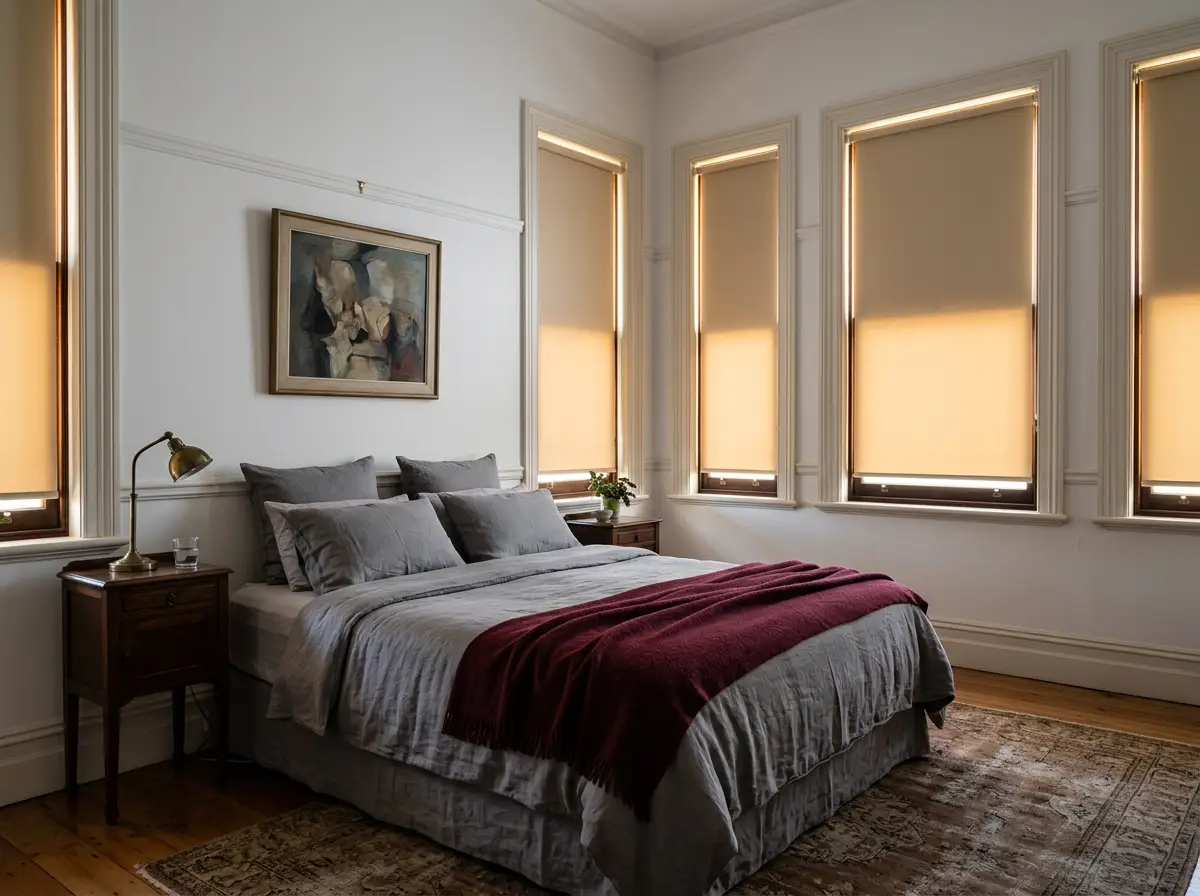
Start with the elevation, not the swatch book
Johannesburg sits at roughly 26 degrees south, so the sun tracks across the northern sky. That single fact sorts most Dunkeld windows before anyone opens a fabric folder.
- North-facing — warm and generous in June, punishing by ten in the morning in December. This elevation usually wants sunscreen rather than a heavy blockout: the light needs managing, not evicting.
- West-facing — the hard one. From roughly two o'clock on a summer afternoon a west window becomes a heat source, and no interior fabric stops heat that is already through the glass. A dark low-openness sunscreen helps. An external product helps more, and we will say so.
- South-facing — even, cool, almost no direct sun all year. These rooms are about privacy and a little winter warmth, so a light-filtering fabric generally does everything asked of it.
- East-facing — bright early, finished by lunch. Bedrooms on this side are the classic blockout case in Dunkeld, because the sun arrives earlier than anyone wants it to.
Then the tree question
Much of Dunkeld lives under mature oaks and plane trees. In February a garden-facing lounge can sit in deep green shade all day; by August the same window is wide open to the sky because the leaves are on the lawn.
People choose fabric in summer, under the canopy, then wonder why the room glares in winter. Pick for the bare-branch condition. Where you genuinely need both, that is what a double roller is for.
Three fabrics, three separate jobs
- Sunscreen — an open mesh, specified by openness factor. 3% and 5% hold back more heat and glare and give up a little of the view; 10% keeps the garden crisp but works less hard. On big glass over a lawn, 5% is the honest middle.
- Blockout — a coated cloth that stops light dead. Worth knowing up front: there is always a thin light gap down each side unless the blind is face-fixed generously wide, so a properly dark bedroom is a blockout fabric plus a sensible fitting decision.
- Light-filtering — privacy by day and by night with a soft glow through, no view out. Bathrooms, landings, and any room a neighbouring second storey looks into.
The fitting detail that catches people out here
Plenty of Dunkeld's original houses still carry their steel casement windows, and a steel casement has a winder handle that swings into the room. Fit a roller neatly inside that reveal and the handle fouls the fabric every time the window opens. The answer is a face-fixed blind on the wall above the opening, or a spacer bracket. Not difficult — but it has to be decided at the measure, not on installation morning.
Deep reveals are the other local quirk. Old plastered walls in this pocket are thick, and a blind sunk right back into a deep reveal loses its shadow line and reads as an afterthought. Forward is sometimes better.
Hardware you live with daily
- Control — side chain with a child-safe tensioner screwed to the wall as standard, spring-assist on small windows, a motor for anything high, wide, or sitting behind furniture.
- Double roller — sunscreen and blockout sharing one twin bracket. The most-fitted product on these streets, and the tree canopy above is the reason.
- Cassette or pelmet — a colour-matched fascia over the tube. It tidies the top edge and keeps dust off the roll, which matters more than it sounds through a dry Highveld winter.
First: past roughly three metres of unbroken fabric a roller begins to sag, crease and track off centre. Beyond that width the right answer is a join line, or two linked motorised blinds — not a heroic single blind that disappoints in year two. Second: in a room with real period proportions, deep timber reveals and a sash window, a roller can simply look wrong however well it is made. A timber venetian usually sits better there, and we will say so at the measure even when it is not what you asked us to quote.
Questions we get asked on Dunkeld driveways
My windows are old steel casements — will a roller even work?
Almost always, yes. Face-fixed above the opening rather than sunk into the reveal, so the winder handle stays clear. We check handle swing and reveal depth at the measure and write the fixing method onto the quote so there are no surprises.
Will a roller keep the afternoon heat out of a west-facing room?
It will cut the glare properly and take the edge off. It will not stop the heat, because by the time the fabric sees the sun that energy is already inside the glass. If the room is genuinely uncomfortable, ask about external shading instead. Different budget, different conversation — but pretending an interior blind solves it wastes your money.
What happens in a Highveld thunderstorm?
Interior rollers are indoors, so nothing. Two small habits help: a chain-operated blind at an open window will knock about in a gusty afternoon, and fabric that has caught rain should be left down to dry rather than rolled up damp.
How do I clean them?
Dry microfibre cloth, top to bottom, roughly monthly through the dusty months. Spot-clean marks with a barely damp cloth and let it dry fully before rolling up. No solvents and no scrubbing — on a blockout the coating is the part doing the work.